
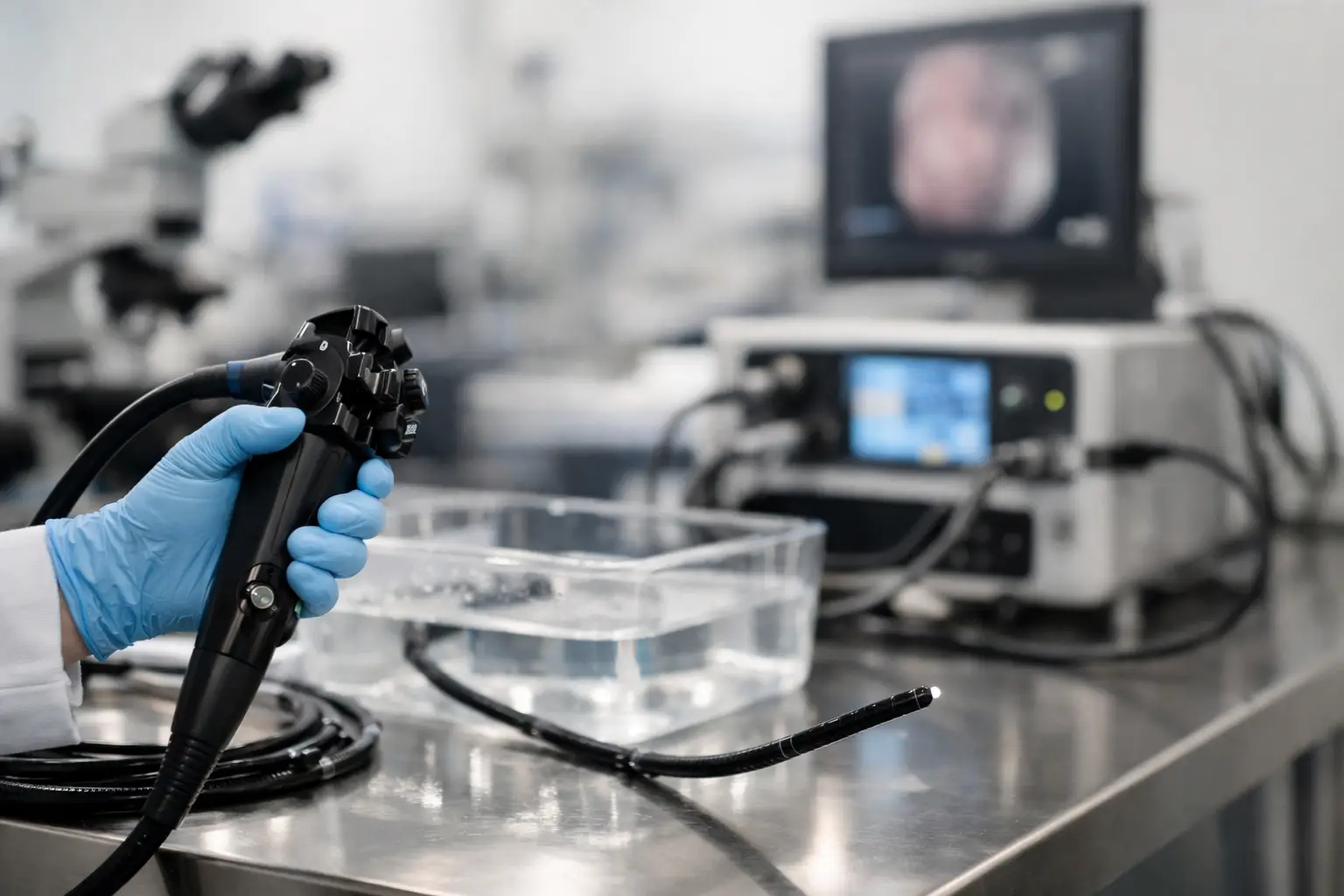
Medical Endoscope Performance Testing
A failed image quality check late in verification does more than delay a project. For an endoscope manufacturer, it can force design rework, repeat testing, and a fresh review of whether the device still meets its intended clinical claims. That is why selecting an endoscope performance testing lab is not a purchasing detail. It is a technical and regulatory decision that affects development timelines, submission quality, and market readiness.
Endoscope systems sit at the intersection of optics, mechanics, electrical safety, usability, and reprocessing expectations. Their performance cannot be reduced to a single pass-fail result. Manufacturers need laboratory data that shows how the device performs under defined conditions, how that performance aligns with applicable standards, and how the resulting documentation supports design verification and regulatory review.
What an endoscope performance testing lab should actually provide
A capable endoscope performance testing lab should do more than run isolated bench checks. The core value is disciplined, standards-aligned testing that produces data regulatory teams can use and engineering teams can trust. That starts with a clear test plan tied to the device type, intended use, and applicable acceptance criteria.
For rigid and flexible endoscopes, performance evaluation often includes optical characteristics such as image resolution, field of view, distortion, illumination uniformity, and depth of field. Those are not interchangeable metrics. A device may perform well in one area and poorly in another, which is why test design matters. If the lab does not understand how these parameters interact with clinical use, the resulting data may be technically correct but still weak for design decisions.
The lab should also understand that endoscope performance is often system-level. The insertion tube, distal optics, light source, camera control unit, display chain, and associated accessories can all affect final image quality and usability. In some projects, component-level testing is enough. In others, especially when manufacturers are supporting commercial claims or substantial design changes, integrated system testing is the more defensible approach.
Why accreditation matters in endoscope performance testing lab selection
Accreditation is not a marketing credential. It is an indicator that the lab operates under a recognized quality framework for competence, method control, equipment calibration, and traceable documentation. For medical device manufacturers, that matters because the test report may become part of a design history file, a regulatory submission, or a response to an agency question.
An endoscope performance testing lab working under ISO/IEC 17025 should have defined procedures for method validation, uncertainty where applicable, equipment maintenance, record control, and corrective action. That does not mean every accredited lab is equally strong in endoscope work. Scope matters. Manufacturers should confirm that the lab’s actual technical experience and accredited capabilities align with the specific endoscope category and the standards or methods relevant to the project.
For companies preparing submissions in the United States, regulatory alignment has added weight. A lab that understands how standards-based testing supports FDA expectations can help prevent avoidable gaps in documentation. The benefit is not only technical execution. It is clearer evidence packages and fewer surprises when submission materials are assembled.
The performance areas that usually deserve the most scrutiny
Image quality is usually the first concern, but it is rarely the only one that drives risk. Resolution may look acceptable in controlled conditions while brightness, contrast, or geometric distortion creates practical issues at the user level. A good lab will define the test setup carefully enough that results are repeatable and meaningful, not just visually persuasive.
Illumination performance is another area where weak methods can create false confidence. Light output, spatial uniformity, and color characteristics can change based on coupling conditions, aging, and the full optical path. If the device is intended for procedures where anatomy identification depends on subtle visual differences, those variables deserve tighter control.
Mechanical durability can also affect performance outcomes. Repeated articulation, insertion, bending, or accessory use may degrade optical alignment or image consistency over time. This is where trade-offs often appear. Early-phase developers may only need baseline performance characterization. Later-stage programs may need performance testing before and after simulated use, cleaning cycles, or other conditioning steps to demonstrate that the device continues to meet specifications.
Electrical and basic safety considerations should not be treated as separate from performance simply because they may be handled under different standards. In powered endoscope systems, electrical characteristics, thermal behavior, and compatibility between connected components can influence both safe operation and image function. A laboratory with broader medical device testing capability can often evaluate these interactions more efficiently than a narrowly scoped vendor.
Test planning should follow the device, not a generic package
Manufacturers should be cautious with off-the-shelf testing bundles that are presented as universally sufficient. Endoscope platforms vary widely by design, intended anatomy, imaging modality, and market pathway. A reusable flexible endoscope, a single-use visualization device, and a rigid arthroscopic scope do not raise identical verification questions.
The strongest labs begin with the device’s intended use, technological characteristics, and likely regulatory needs. From there, the test program can be mapped to specific standards, internal specifications, risk controls, and performance claims. That planning step often determines whether the final report is genuinely useful. A report can be perfectly organized and still miss the data points the manufacturer actually needs.
This is also the stage where acceptance criteria need discipline. Some criteria come directly from recognized standards. Others are design inputs set by the manufacturer. Others may need scientific justification based on predicate performance, clinical expectations, or risk analysis. When those sources are mixed without clear rationale, verification becomes harder to defend.
Documentation quality is part of the deliverable
For regulatory and quality teams, the value of testing is inseparable from the quality of the records. Raw data, environmental conditions, equipment identification, calibration status, test setup description, deviations, statistical treatment where relevant, and final conclusions all need to be documented in a way that can withstand review.
This is where experienced labs distinguish themselves. Engineers may understand the device well, but if the report language is vague or the methods are not traceable, the data becomes harder to use in formal submissions. Conversely, a clear report can support multiple downstream needs, including design verification, risk management updates, internal technical review, and agency correspondence.
Responsiveness matters here too. Projects often move under compressed development timelines, and manufacturers need timely quote turnaround, clear scheduling, and direct communication when a method requires adaptation. Speed alone is not enough. Fast testing with weak documentation usually costs more time later.
When to involve an endoscope performance testing lab
The best time to engage an endoscope performance testing lab depends on the maturity of the product. For early development, the lab can help characterize baseline optical and system behavior before design inputs are locked. That can reduce expensive iteration later, especially when image quality complaints are likely to emerge only after integration.
For formal verification, the lab’s role becomes more controlled and documentation-focused. By this stage, fixtures, sample selection, conditioning, and acceptance criteria should be tightly defined. If the device is nearing submission, manufacturers should avoid treating laboratory engagement as a final checkbox. Any ambiguity in methods or claims can slow the entire file.
There is also value in using the lab after design changes. A modified sensor, revised illumination path, updated software, or new accessory can alter performance in ways that are not obvious from engineering judgment alone. Targeted retesting is often more efficient than defending assumptions during review.
What sophisticated buyers usually ask before awarding the work
Experienced regulatory and engineering teams tend to ask practical questions. Is the method based on a recognized standard, an internal validated protocol, or a hybrid approach? Does the lab have direct experience with the specific endoscope type? Can the test setup simulate actual use conditions closely enough to make the data relevant? How are deviations handled? What does the final report include?
They also ask a less visible but equally important question: will this lab help create evidence that stands up under scrutiny? That question combines technical competence, quality discipline, and regulatory awareness. In a specialized field like endoscope testing, all three are necessary.
Sigma Scientific Services operates in that space with ISO/IEC 17025 accreditation, FDA ASCA program recognition, and a testing model built around standards-based medical device evaluation. For manufacturers managing verification schedules and submission risk, that kind of alignment is often the difference between generating data and generating usable evidence.
A strong lab relationship should make the next decision easier, not harder. If your endoscope testing partner can define the right method, execute it consistently, and document it for real regulatory use, you are not just buying a report. You are reducing uncertainty where it matters most.
Contact Us for More Information